
Utilities
A distribution estate is hundreds of small OT sites that must all be answered for.
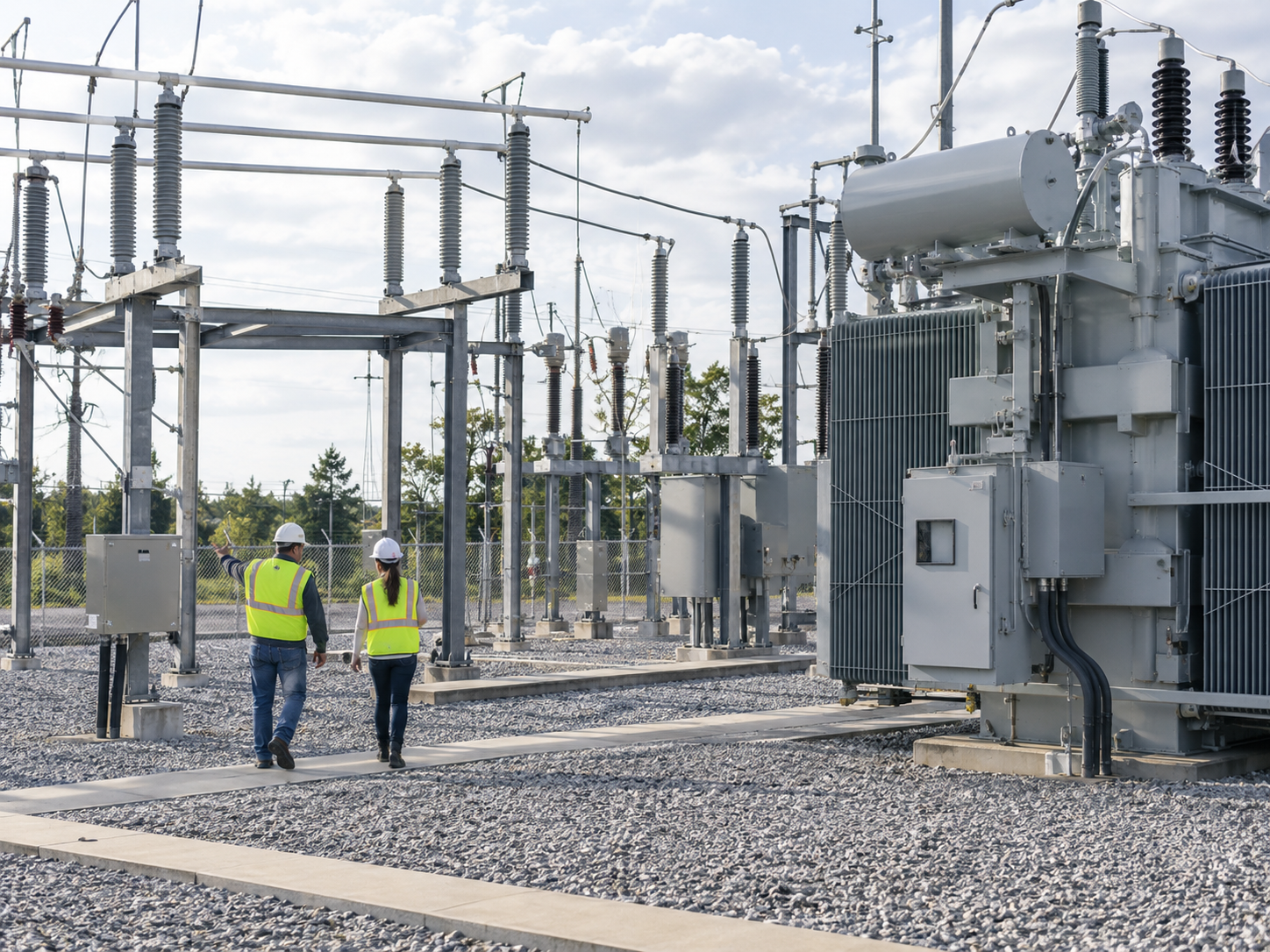
Substations are unstaffed, nearly identical, and connected to a control centre over links somebody else owns. The assurance question is rarely about one site: it is whether the same statement can be made about all of them, and whether the answer still holds when the next one is added.
- Substation, control centre and enterprise as canonical zones, not as a drawing
- The protection and control boundary modelled as conduits with their own channels
- IEC 62443-3-2 risk and 3-3 requirements against a confirmed target per zone
- NIS2 readiness on the same estate, not a second exercise
Understand the environment
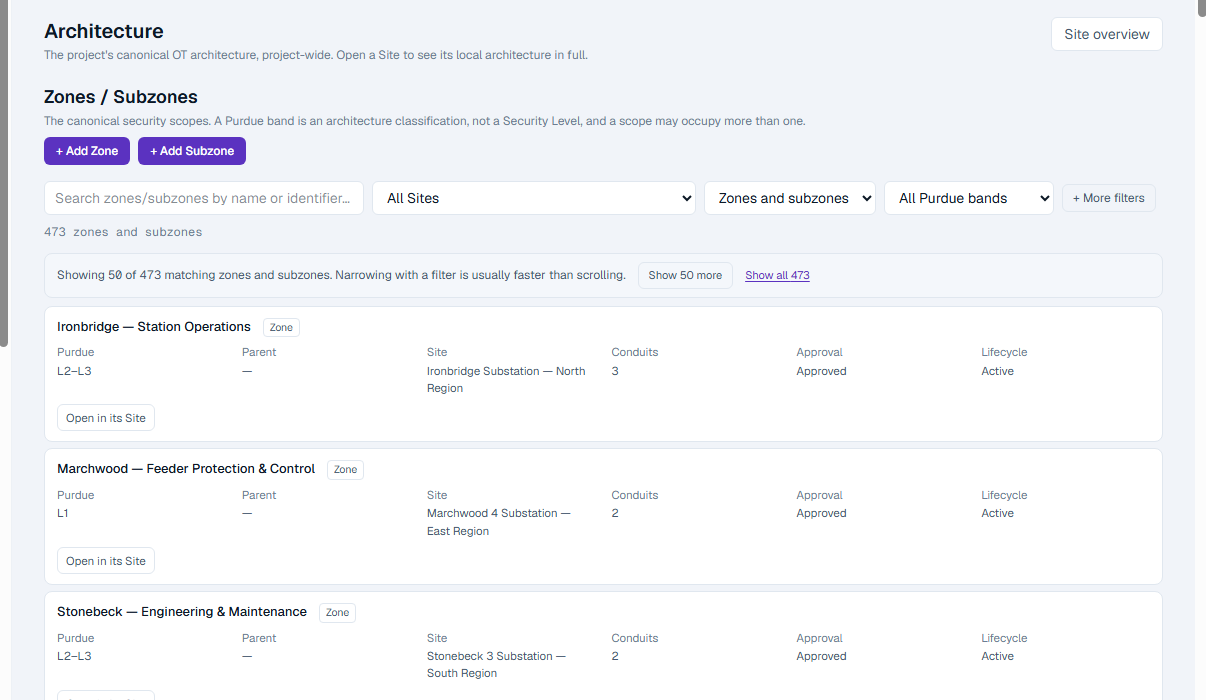
The estate is the problem, not the site.
A single substation is not hard to describe: a station bus, a set of protection and control IEDs, a gateway to the regional control centre, and a small number of links that leave the fence. What makes distribution difficult is that there are a hundred of them, they were commissioned across three decades, and no two are quite the same despite being described in the same standard drawing.
So the questions that matter are estate questions. Which stations still carry an unauthenticated telecontrol protocol. Which ones have a vendor path that nobody has reviewed since commissioning. Which are inside the scope of the assessment that was signed off last quarter, and which were added after it. Those are answerable only if every station is the same kind of object in the same model.
Availability is the operating constraint behind all of it. A substation cannot be taken out of service to be assessed, a protection relay cannot be scanned, and a maintenance window is measured in hours per year. Assurance work in this environment is largely documentary and architectural, which is precisely what this product is for.
- Brownfield is the normal case, not the exception
- The same zone pattern repeated across many sites, with real local variation
- Remote sites with no operator present during an incident
- Third-party links: telecoms carriers, protection vendors, metering providers
Terminology
What OTReady calls things here.
The objects are the product's own. The names in them are the operator's, because a model that renames a customer's estate is a model they have to translate before they can use it.
- Site
- A substation, a control centre, a regional depot. Physical grouping only: a Site confers no security scope and inherits nothing.
- Zone and Subzone
- Station bus, protection and control, telecontrol gateway, station services. A Subzone is a zone inside a zone, with its own target and its own conclusions.
- Conduit
- The security relationship between two zones. The telecontrol path from station to control centre is one conduit, whatever it physically runs over.
- Communication Channel
- What that conduit actually carries: IEC 60870-5-104 telecontrol, IEC 61850 station bus traffic, an engineering session, syslog. Protocol, direction and encryption state live here, per channel.
- OT Domain
- Functional context in the operator's words: protection, telecontrol, metering, station services. Assigned across zones, conduits, channels and assets at once.
Conduit and channel
One telecontrol link, several different behaviours.
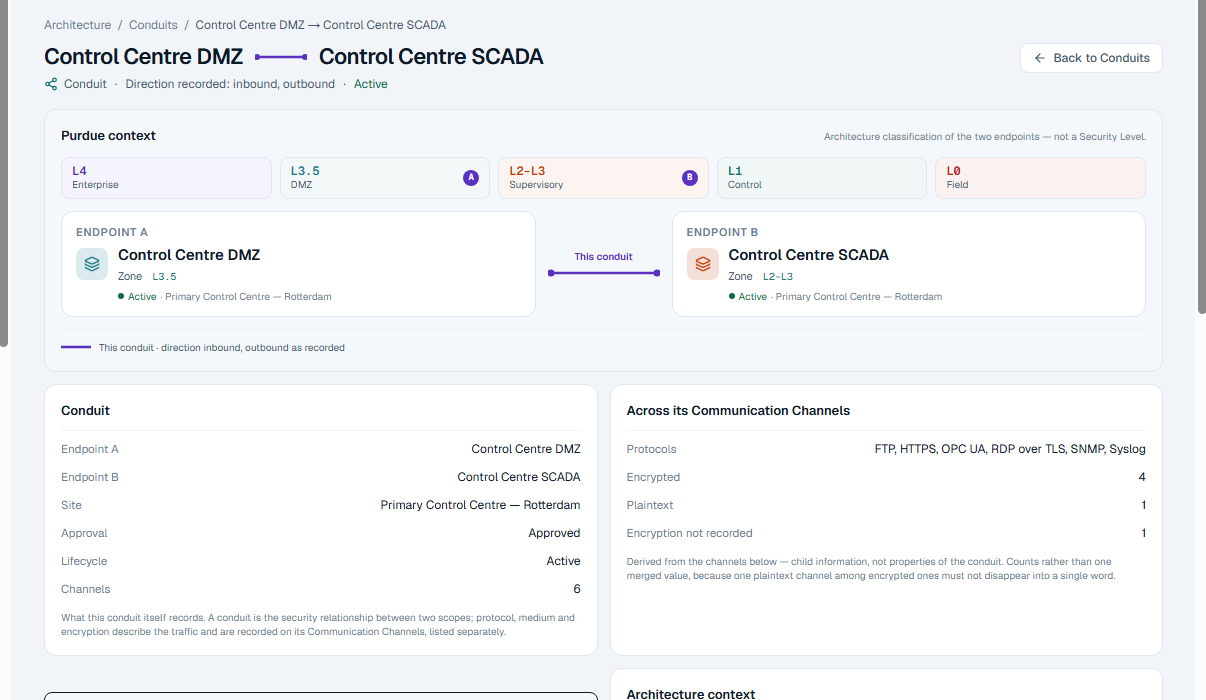
A distribution operator will describe the link between a substation and the control centre as one thing. Inside it there are usually several: the telecontrol protocol itself, a file transfer somebody set up for fault records, a vendor session for protection settings, and a log feed.
OTReady keeps the relationship and the traffic apart. The Conduit is the relationship and carries the target; each Channel carries its own protocol, direction and encryption state. Collapsing them would hide exactly the one channel that matters, and encryption is three-valued: encrypted, not encrypted, and not recorded, which is never read as safe.
How OTReady applies
The same chain, on a distribution estate.
Nothing about the product changes for a sector. What changes is what the objects are called and what the answers turn out to be.
- OT context
- Architecture
- Risk
- Targets
- Assessments
- Findings & Evidence
- Remediation
- Reports
Each step points back at the part of the estate it is about: a Finding names the substation zone or the conduit it concerns, and stays pointed at it through remediation and into the issued report.
Assurance
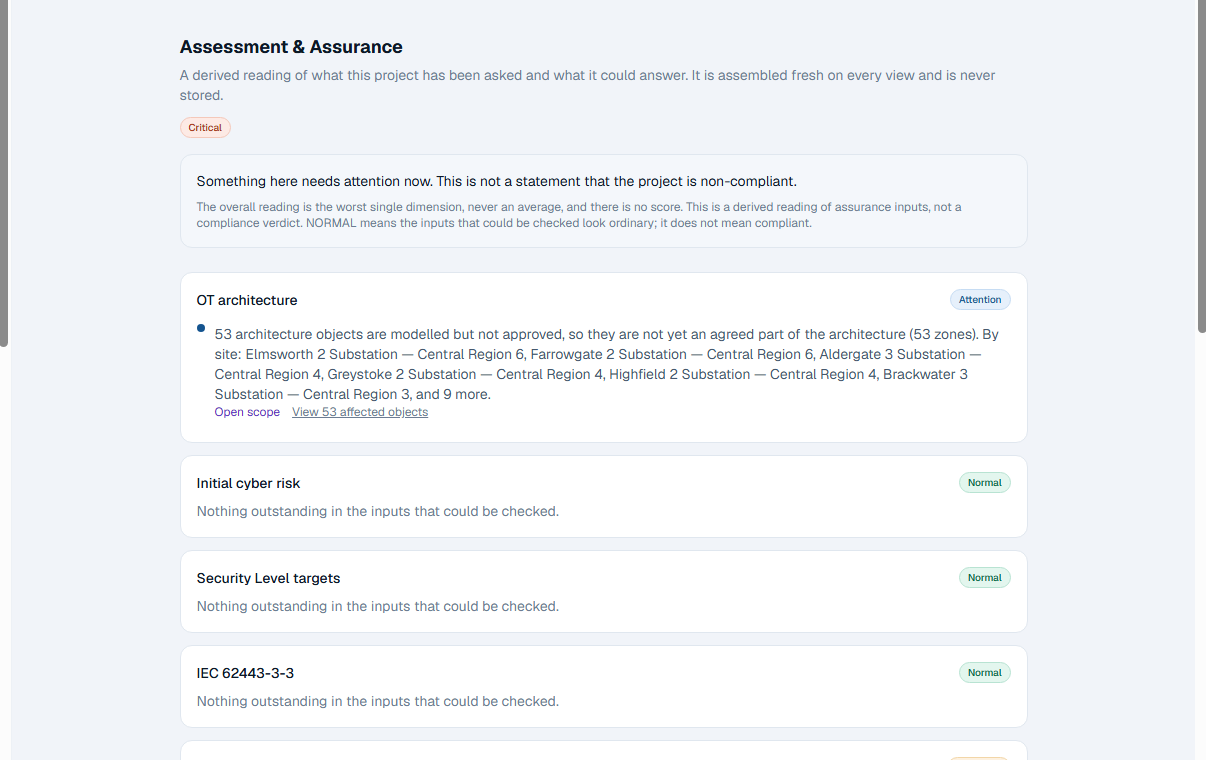
One reading of the estate, with the reason beside it.
Nine dimensions, each stated as a word with its reason, and no overall score. A distribution estate mid-programme does not have a single number, and a page that printed one would be inventing the part the reader most wants.
Findings
Every finding names the part of the network it is about.
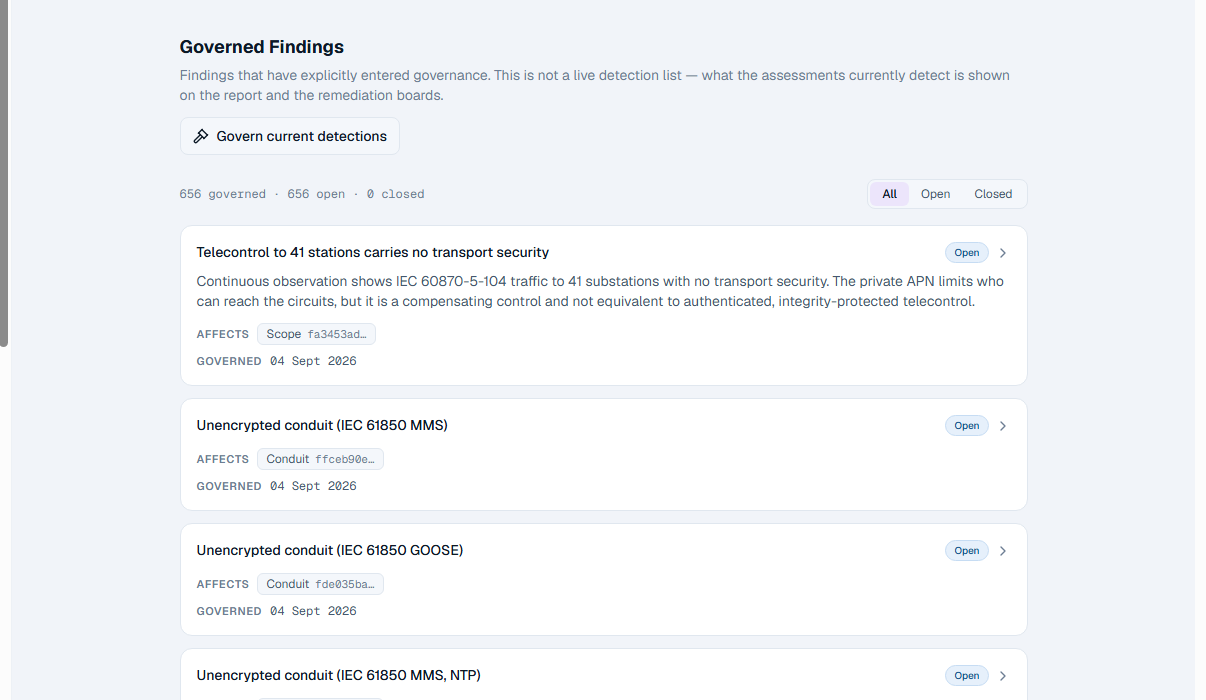
A finding that says "weak remote access" for a hundred substations is a sentence, not a work item. Here each one is attributed to a canonical object: this zone, this conduit, this channel. That is what lets a regional programme be planned by site and still be reported as one position.
Findings are governed: a treatment decision is recorded, verified closure requires linked and approved work, and none of it is asserted.
Representative use cases
What operators actually bring to it.
- A regional distribution estate
- Many substations, one control centre, one repeated zone pattern with real local variation. The question is consistency across sites, not depth at one.
- The protection and control boundary
- Where station bus traffic meets telecontrol, and where an engineering session crosses a boundary that was drawn before anyone asked about it.
- Control centre and enterprise separation
- The conduits between operations and corporate, and what each of them genuinely carries once the channels are written down.
- NIS2 as an essential entity
- Readiness assessed on the same estate the IEC 62443 work used, so the two are answers about one plant rather than two exercises.
What this page does and does not claim.
OTReady is one platform configured for this environment, with an accepted demo estate behind the screenshots above. It is not a utilities edition, not a substation template, and not a certification. It does not read from your SCADA, your protection relays or your telecontrol network, and it changes nothing on the plant.
Where the detail lives
OT architecture
Sites, Zones, Subzones, Conduits and the Channels inside them.
Risk and targets
IEC 62443-3-2 risk, and confirmed Target Security Levels per zone.
Assurance
The nine dimensions, and why there is no score.
See OTReady against your own distribution estate.
A working session on your substations, your control centre and the conduits between them.