
Manufacturing
The line cannot stop, and the cell was commissioned by somebody else.
A plant is a set of production cells with their own controllers, their own vendors and their own idea of what a network is, joined to an enterprise that wants data out of them. The assurance question is where those joins are, and what each of them actually carries.
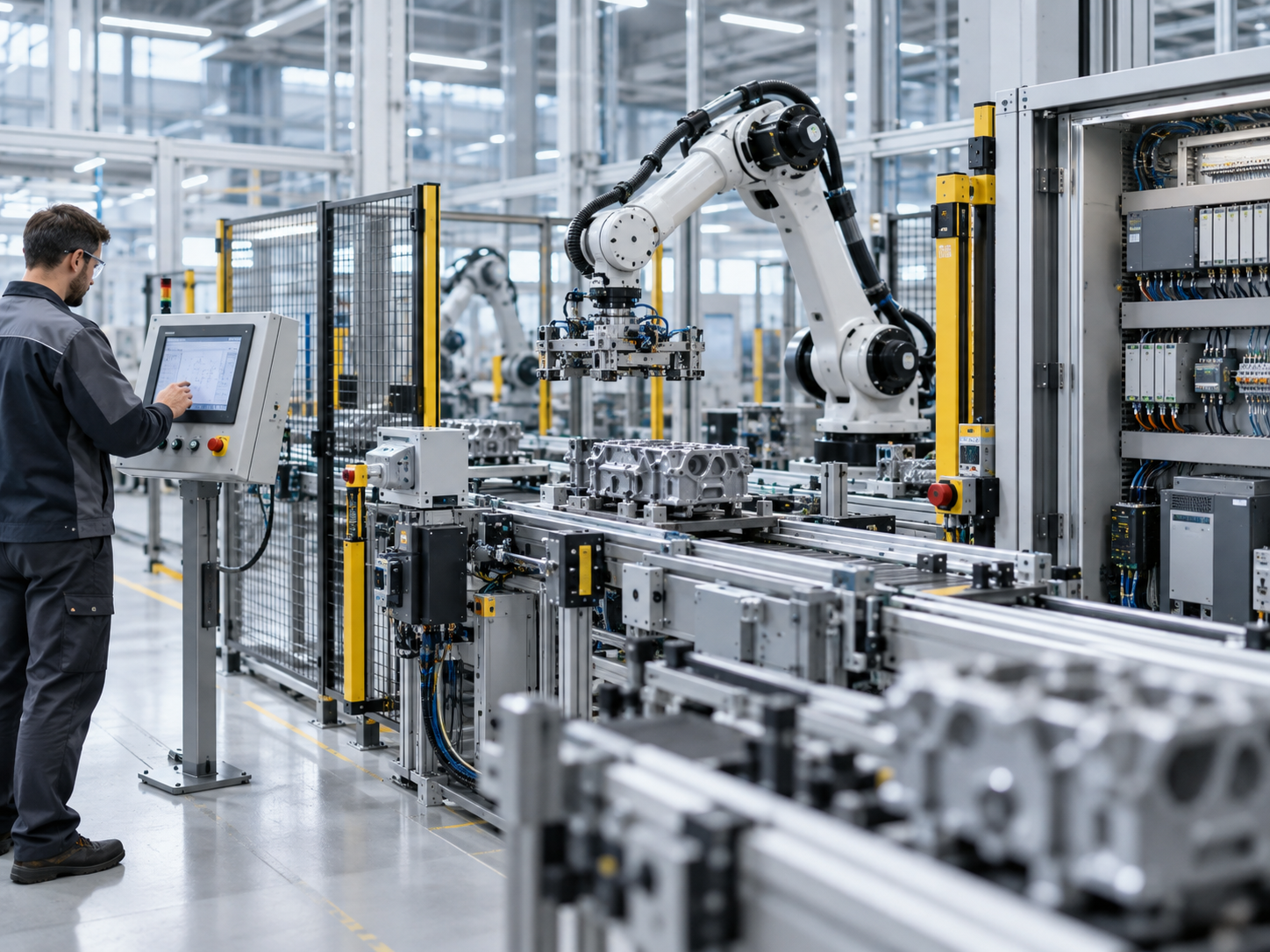
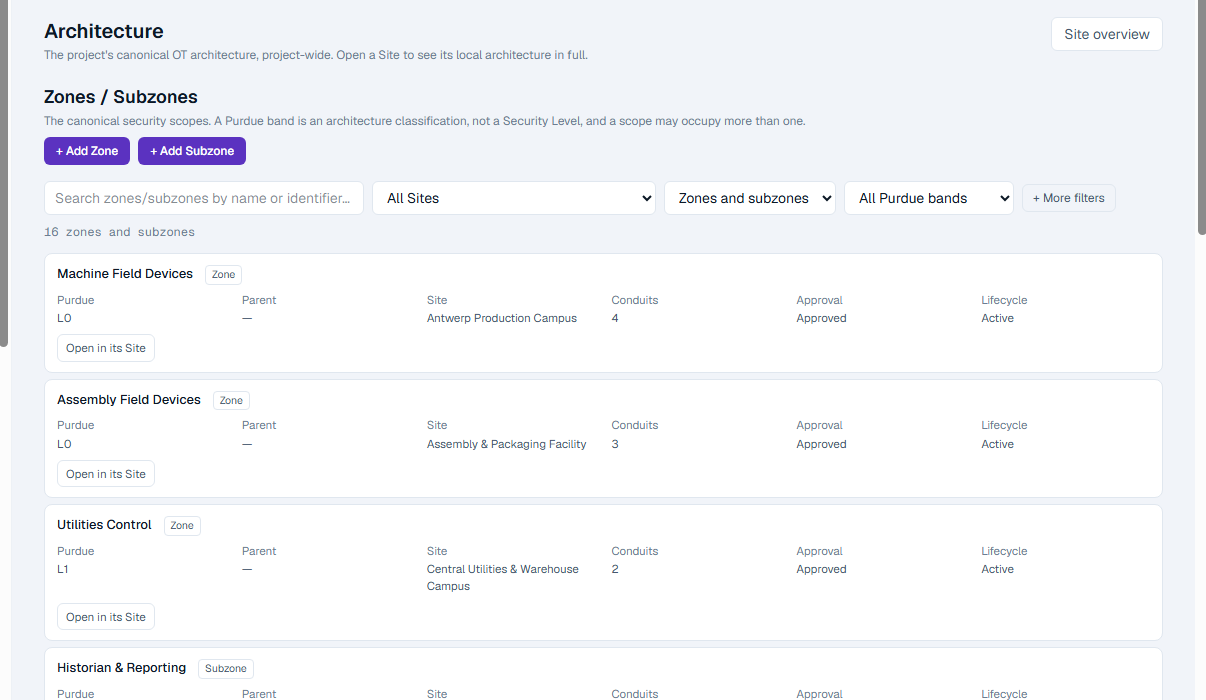
- Cells, line control and plant operations as canonical zones and subzones
- The OT/IT boundary modelled as conduits, with each channel written down separately
- Vendor and engineering access treated as what it is: a path into control
- IEC 62443 and NIS2 answered from one estate
Understand the environment
A plant is a collection of other people's designs.
Machining cells, robotic assembly, packaging: each arrived as a delivered system with its own controller, its own HMI and its own commissioning engineer. They were joined to a plant network afterwards, and the joins are where the assurance questions live.
Availability governs everything. A cell cannot be taken down to be scanned, a safety controller is not something anyone experiments with, and a change window is negotiated against production. What is achievable is knowing precisely what the architecture is, what each link carries, and which of those links crosses a boundary nobody agreed to.
The OT/IT boundary is rarely one line. There is a documented one, and then there are the quiet ones: the MES broker, the historian mirror, the vendor jump host, the engineering laptop that has to reach both sides. All of them are real, and all of them belong in the model rather than in somebody's memory.
- Multi-line and multi-site, with cells that differ by vendor rather than by design
- Legacy machines that cannot be patched and will not be replaced this year
- Vendor remote support as a standing path, not an event
- Safety systems that must be modelled without being experimented on
Terminology
What OTReady calls things here.
- Site
- A campus, a plant, an assembly facility. Physical grouping; it inherits nothing.
- Zone and Subzone
- Plant operations, machining cells, robotic assembly, packaging, safety systems. A cell with its own target becomes a Subzone of the line it belongs to.
- Conduit
- Plant operations to a cell; the DMZ to engineering. The relationship, with its own required Security Level.
- Communication Channel
- PROFINET cell traffic, OPC UA to the historian, a vendor SSH session, an FTP program transfer. Each with its own encryption state, including "not recorded".
- OT Domain
- Production, quality, plant utilities, maintenance and engineering, data and integration. The plant's own words, not a taxonomy OTReady ships.
Conduit and channel
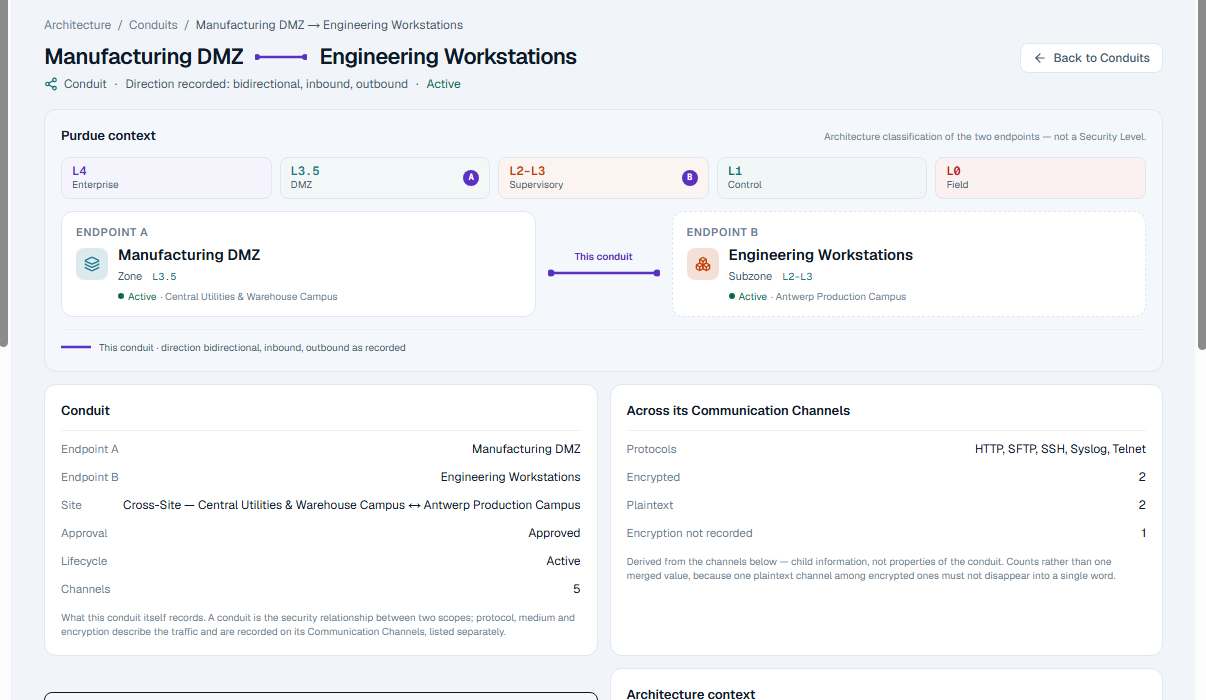
The vendor path is one conduit and five different answers.
Vendor remote support is usually described as a single arrangement. Opened up, it is an SSH session, a file exchange, a licence check over plain HTTP, a log feed nobody configured, and a legacy diagnostics tunnel that predates the current network.
Each of those is a Channel with its own protocol, direction and encryption state. The Conduit carries the target; the Channels carry the facts. A single "encrypted" for the whole relationship would be the most reassuring and least true thing on the page.
How OTReady applies
The same chain, on a plant.
- OT context
- Architecture
- Risk
- Targets
- Assessments
- Findings & Evidence
- Remediation
- Reports
A Finding raised against a machining cell names that cell, and is still naming it when the remediation task is verified and the report is issued.
Assurance
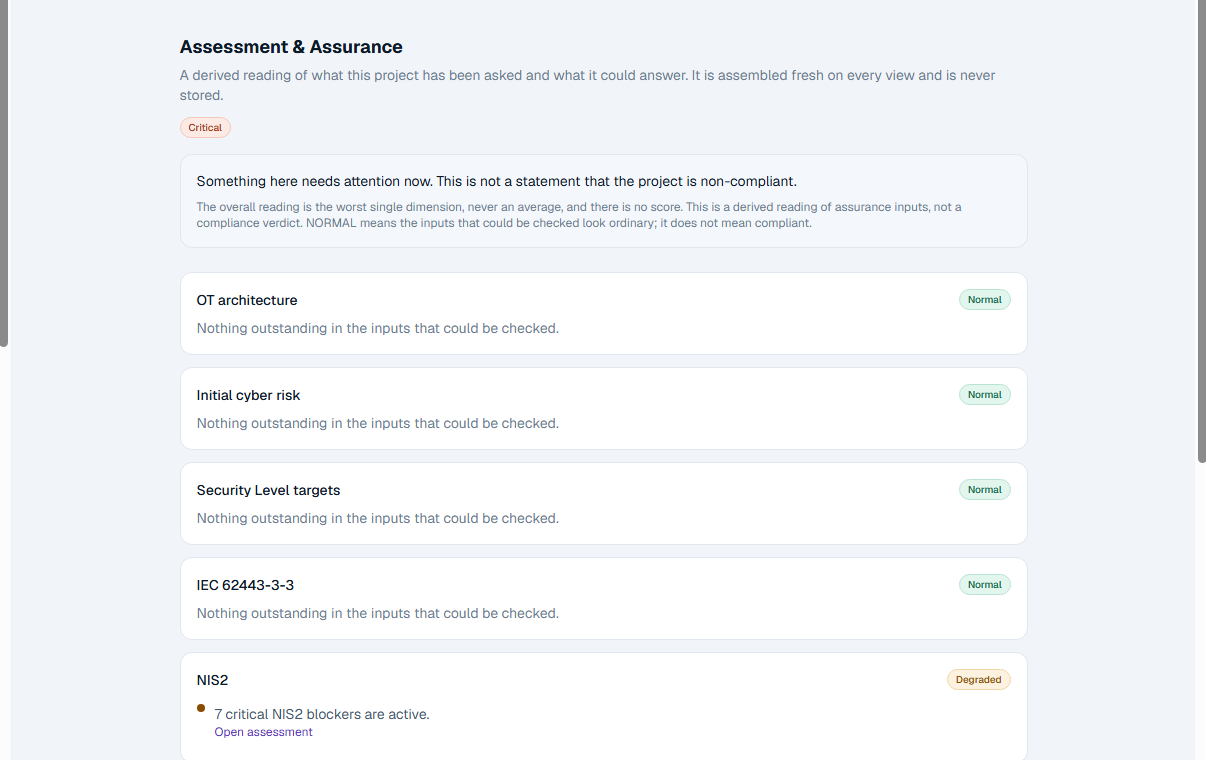
Where the plant actually stands.
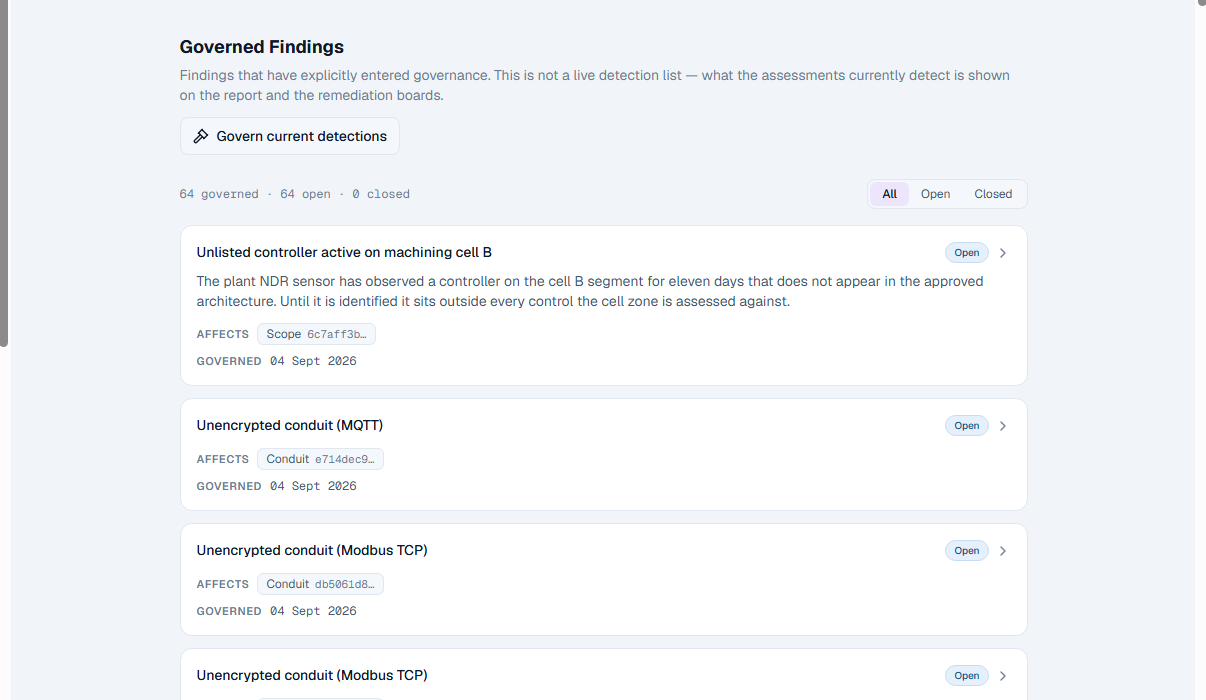
Findings
Attributed to the cell, not to the plant.
"Legacy protocol in use" is true of most plants and actionable in none of them. A Finding here names the zone, the conduit or the channel it concerns, which is what makes it plannable against a shutdown window and reportable afterwards.
Representative use cases
What plants actually bring to it.
- A production line, cell by cell
- Each cell as its own zone with its own target, so a conclusion about one is not quietly a conclusion about all of them.
- The OT/IT boundary
- The documented boundary and the undocumented ones, written down as conduits with their channels enumerated.
- Vendor and engineering access
- Standing paths into control, modelled as what they are rather than as an exception somebody remembers.
- Multi-site manufacturing
- Several plants under one programme, each an estate in its own right, answered consistently.
What this page does and does not claim.
The platform and a full working demo support this sector. There is no dedicated manufacturing template and no accelerator, and none is implied: what you see is the standard OTReady model with a plant's own vocabulary in it. OTReady reads nothing from your cells and changes nothing on them.
Where the detail lives
OT architecture
Zones, Subzones, Conduits and the Channels inside them.
OT Domains
Functional context, modelled separately from security architecture.
Remediation
One board, from governed Finding to reviewed closure.
See OTReady against your own plant.
A working session on your cells, your line control and the boundary between OT and IT.